
There’s a moment, right before the dinner rush breaks open, when a kitchen reveals its truth.
It either moves like a well-rehearsed ballet or feels like you’re gearing up for impact.
And that split second tells you everything you need to know about your commercial kitchen design, long before the first ticket curls out of the printer.
After redesigning more than 50 restaurant kitchens, we’ve seen the same shift play out again and again at Studio M.
Chaos softens into choreography.
Spaces stop resisting the people working in them and start lifting them up.
If you’ve ever seen a line cook glide through service instead of scrambling, you know exactly how dramatic that shift can be.
The Three-Second Rule
Next time you’re in a kitchen at peak rush, watch a cook for a full minute.
Count the seconds between thinking and doing.
In a well-designed commercial kitchen, that gap almost disappears.
It’s wild how much efficiency hides inside those tiny, almost invisible movements.
We once talked to a chef who said he had to compensate for a badly placed lowboy hundreds of times in a single service.
Four inches too far left.
Twenty minutes lost to pure spatial friction.
Multiply that over a year and tell me design doesn’t touch profitability.
Turns out, watching your kitchen stop fighting itself with efficient kitchen layout design is well worth the investment, and profit is just the first of many reasons.
Variable Heights
If you want a quick way to make every chef on your team feel seen, start with counter heights.
The default 36 inches really isn’t a standard.
In our mind, it’s a compromise.
NIOSH data shows improper heights increase injury risk (and honestly, your back will confirm that without reading a study).
Here’s what actually works in real kitchens:
- Prep stations: 38″ for strong knife control
- Plating: 34″ for tighter precision
- The pass: 42″ for speed, line of sight, and a little theater
We design around real human bodies, not generic measurements.
It’s amazing how quickly chefs start bragging about faster plating times or reduced hand fatigue due to workplace ergonomics.
The Temperature Map
Every commercial kitchen has its own secret climate zones.
You know them already:
- The hot corner no one wants during summer
- The cold corridor by the walk-in
- The dead air pocket where heat just hangs
Thermal imaging makes these invisible landscapes obvious.
And when operators see where their team is suffering, they suddenly care deeply about strategic spot cooling.
Halton’s research backs this up: shifting perceived temperature even slightly can change productivity dramatically, without blowing up your HVAC bill.
If you want buy-in fast, don’t lead with BTUs.
Lead with, “Here’s where your cooks prefer to work, and why.”
When you’re planning restaurant build-out services, thermal comfort should be a primary consideration.
Sound (A Profit Killer)
Kitchen noise reaches 95 dB during service.
That’s equivalent to a lawnmower running next to your head for hours, and OSHA even considers this hazardous levels of noise exposure.
Sound destroys communication.
Communication errors destroy profits.
One client dealt with ticket mistakes for six months.
They retrained.
They reprimanded.
Nothing changed.
Then we installed acoustic baffles.
Mistakes dropped practically overnight, not because the cooks suddenly improved but because the room finally quieted down.
Commercial kitchen design that ignores acoustics is relaly just leaving money on the table.
The Psychology of the Pass
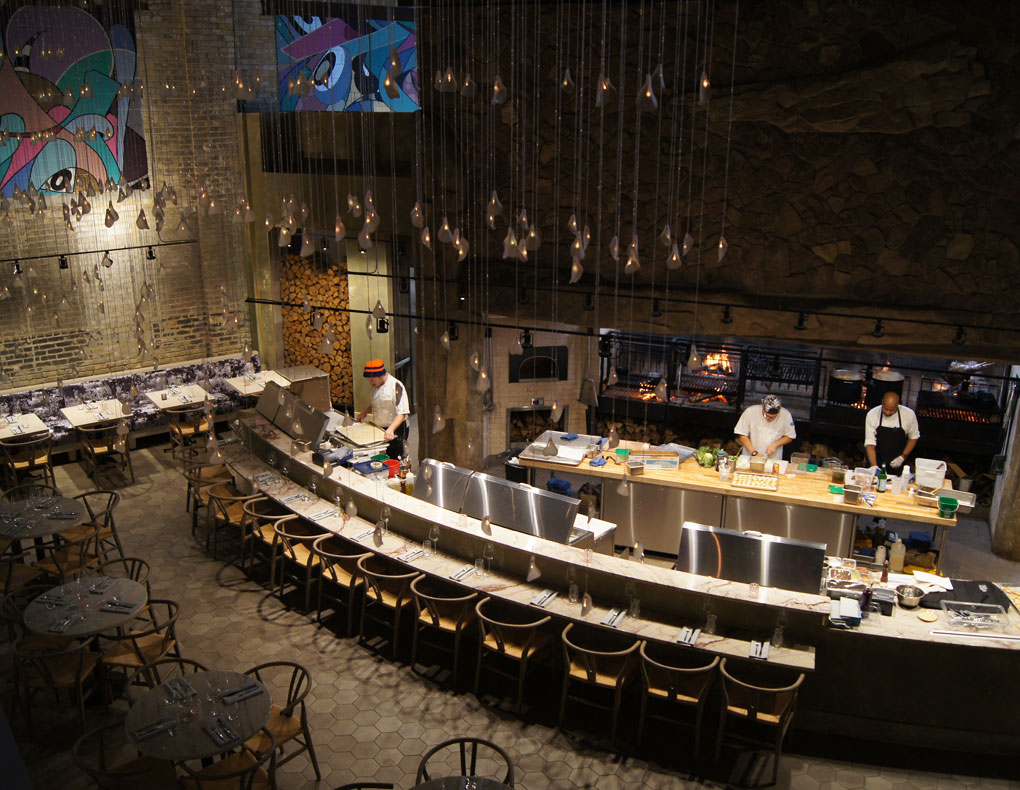
The pass, or the space where kitchen meets dining room, might be the most complex space in any commercial kitchen design.
It’s theater, it’s function, and it’s brand identity all compressed into a few square feet.
Research from Cornell’s School of Hotel Administration shows restaurants with carefully curated open kitchens report higher satisfaction scores.
But only when the design is intentional.
Designing the pass matters:
- Low and wide suggests accessibility
- High and narrow maintains mystique
- Partially open creates theater without exposing chaos
“Show the ballet, not the battle,” as one client perfectly put it to us once.
And naturally, this thinking extends to your commercial open kitchen restaurant design more broadly, beyond that singular “zone,” as well.
Flow Patterns: A Potential Money Maker
People under pressure move like water, finding paths of least resistance.
Fighting natural flow in commercial kitchen design kills productivity, period.
Track a plate’s journey:
Receiving → storage → prep → line → plating → pass → dish → storage.
That’s your circulation map, the flow you start with.
Then, consider that every collision point costs money, time, and morale.
The Culinary Institute of America documents how poor flow increases service times significantly, and in our design services, we translate these insights into ROI language.
Better flow means more covers, higher revenue, and happier guests after all, right?
When planning your restaurant space planning, map the journey first.
That’s our pro tip for this part.
Equipment Relationships Worth Considering
Think of your kitchen equipment like a group of coworkers: some need to sit together, and some absolutely shouldn’t.
You wouldn’t put the office gossip next to the person who hates talking, so don’t park your high-heat diva next to the fridge that just wants a calm, cool day.
Examples:
- Fryer beside prep? Enjoy your oil-spattered mise en place.
- Blast chiller far from pastry? Kiss consistency goodbye.
- Salamander too far from the pass? Slow tickets all night.
In good commercial kitchen design, equipment has conversations:
Walk-ins “talk” to combis, ice machines become hubs, and the fire line supports (instead of sabotaging) the final plate.
Industry research shows that optimized equipment placement can reduce ticket times significantly, and that’s truly measurable ROI you can track from day one.
The Small Kitchen Advantage
Hot take: small kitchens often perform better.
We designed a 400-square-foot commercial kitchen that comfortably pushes 300 covers on a busy night, and their secret is a few key ingredients (if you will):
- Every surface has two jobs
- Equipment earns its footprint
- Vertical space becomes prime real estate
- Stations morph throughout service
In our experience, constraints force clarity, and clarity drives speed.
Our design approach showcases these transformations through before-and-after narratives.
And if you’re working with limited space, retail store design principles can inform your kitchen layout too.
The Human Factor
Design for your team at their worst, watch them shine at their best.
Research shows kitchen injuries spike after hour six.
That’s when your commercial kitchen design needs to work hardest, supporting fatigued bodies and maintaining focus.
At Studio M, we’ve found a few key elements make a surprisingly big difference in a kitchen:
- Anti-fatigue mats because standing for eight hours shouldn’t feel like a medieval torture device.
- Strategic hand sinks placed where people actually use them, not where they look nice on a plan.
- Sight lines for peripheral monitoring so you can keep an eye on everything without turning into a human swivel chair.
And we treat these as design investments, not expenses.
Our hope is that our projects show how thoughtful, ergonomic commercial kitchen design can cut down on workers’ comp claims and boost morale at the same time, sometimes even in the same, swift moment.
This thinking informs all our commercial interior design projects.
Future-Proofing Your Design

Modern commercial kitchen design embraces sustainability as strategy, not trend.
Energy Star reports that efficient kitchen equipment can reduce energy costs by up to 30%, with real savings that compound annually.
Tomorrow’s technologies, ready to bring into your kitchen today:
- Induction cooking because 50% less ambient heat feels like a blessing on a hot service day.
- Energy recovery ventilation, reclaiming energy instead of letting it slip out the exhaust.
- Water recycling systems, saving more than just the planet, but your utility bills too.
- IoT-enabled equipment monitoring, keeping tabs on machines so you don’t have to.
We frame these as future-proofing investments, not gimmicks.
And sustainability works best when it’s about longevity and operational resilience, not just ticking a green box.
Whether you’re tackling commercial office renovation or kitchen design, keep in mind that thinking ahead pays dividends.
Converting Interest to Investment
Here’s a three-step strategy for presenting commercial kitchen design effectively, the Studio M way:
- Start by highlighting the pain points your client is facing, whether it’s service bottlenecks, high staff turnover, or rising energy costs.
- Next, show the solutions in action through video tours, thermal imaging, or detailed flow studies so the improvements are tangible and easy to grasp.
- Finally, prove the ROI by pointing to measurable results (faster ticket times, fewer injuries, and higher staff satisfaction).
Our clients have used this approach with great success, and several of them have reported higher close rates because it turns abstract ideas into something clear, compelling, and impossible to ignore.
When you understand hospitality design expertise, you can speak clients’ language.
Your Commercial Kitchen Design Blueprint
At Studio M, we approach commercial kitchen design as equal parts art and operational science.
Whether you’re planning a full restaurant, a retail-kitchen hybrid, or a cutting-edge commercial space, the core principles remain the same:
- Optimize for flow.
- Design for humans.
- Build for longevity.
Don’t get me wrong, a beautiful kitchen that doesn’t perform is just expensive theater.
But when commercial kitchen design blends aesthetics with ruthless efficiency, your investment can be spun into a genuine golden thread of competitive advantage.
Whether you’re considering modern restaurant interior design or planning commercial building design, the principles remain the same because they’re the most crucial principles, in our experience.
And when the dinner rush is rushing, you need a kitchen design that can power a team with ease and nourish your customers in all ways.
Understanding commercial building design services can help you ask better questions.
Learning about commercial building architectural design helps you understand trade-offs.
And if you’re in specialized markets, exploring unique commercial applications can spark creative solutions.
If you’d like to chat or learn more, don’t hesitate to get in touch with us at Studio M to discover how exceptional commercial kitchen design elevates your entire operation.
Because at the end of the day, your kitchen is the heart of it all, and where your competitive edge gets forged.
Recent Comments