
There’s a brief, split second when interior design for commercial spaces either opens the door to opportunity or swiftly shuts it.
Morning light glints off glass, shadows stretch and slip away, and in that first, still moment, the space reveals its true intentions.
We’ve transformed more than 200 commercial environments with the aim of elevating them from merely functional rooms into inspiring spaces.
And after all those projects, one truth has become undeniable: the right design is strategic in ways that extend far beyond decoration.
The impact of interior design reaches into almost every aspect of a restaurant or retail space’s daily functioning, yet it is almost always overlooked.
When done thoughtfully, though, it’s a behavior-shaping mechanism.
It can, really and truly, boost efficiency and make people feel at home.
That’s true even in the busiest, noisiest corners of your business.
The Seven-Second Conversion
Seven seconds.
That’s not a long time, but it’s all you get for a first impression.
Research from the International Interior Design Association confirms this critical window: seven seconds to win or lose a client, to establish credibility, to signal value.
When you think of your lobby, consider how it isn’t just an entrance.
To reduce it to that alone is a major oversimplification, and it misses a lot.
Get creative: is it a decompression chamber between worlds?
Do you want it to act as a psychological threshold that shapes every interaction to come?
This is your first-impression opportunity.
And in our experience, truly smart interior design for commercial spaces orchestrates those few seconds with temperature shifts, acoustic cues, changing light, and the tactile interplay of materials.
There’s a lot you can do upon entry, and it’s the small details here that readily set the tone.
Light as Emotional Architecture
Light is the architect of emotion.
Sounds poetic enough, right? But it’s also undeniably true, and there’s something exciting (and fortunate!) about the possibilities in that for architectural and design purposes.
Morning light energizes, while afternoon light softens.
Evening light is forgiving (thank goodness, I’m sure we’ve all thought from time to time).
Lighting designers call this “atmospheric” territory, and it’s one of the most potent tools in the box when it comes to interior design for commercial spaces (at least in our opinion here at Studio M).
It’s the emotional weather that shapes every interaction within your space, and in our view, the best interior design for commercial environments harnesses this deliberately.
We’ve designed rooms that take on entirely different personalities depending on the hour.
Take one conference room, for example, which shifts moods three times a day:
- 8 AM brings sharp, decision-making eastern light to focus the mind.
- 2 PM offers strategic overhead diffusion that encourages collaboration.
- 6 PM provides warm, celebratory western light that relaxes people and opens conversation.
We’ve even captured these adjustments through time-lapse videos, showing the daily journey of light across the space.
This approach tends to generate far more shares than static photography, because it reveals the living, breathing nature of thoughtfully designed environments.
And when considering retail spaces that shows off products in top form or restaurant interior design that ensures a bright, cozy, or magical dining experience, lighting is everything.
Material Conversations

Marble speaks of luxury.
Concrete tells the truth.
And wood is kind of cozy and comforting, isn’t it?
Breakthrough interior design for commercial spaces sparks material dialogues, conversations between surfaces that tell richer stories than any single material could on its own.
Real magic happens in the right combinations, such as Venetian plaster paired with raw steel or warm oak balancing industrial brass.
At Studio M, we have discovered again and again that authenticity matters more than ever in commercial design.
Your fingertips can tell veneer from solid oak, and your body knows real stone from composite.
These truths accumulate into atmosphere, into the ineffable quality that makes a space feel right.
With that in mind, we try to emphasize material honesty by tracking patina development and documenting wear patterns.
And this kind of thinking extends to our commercial interior design across all sectors.
A little Studio M aphorism, if you will: beauty that grows more compelling with time always outperforms beauty that fades.
Boundaries That Breathe
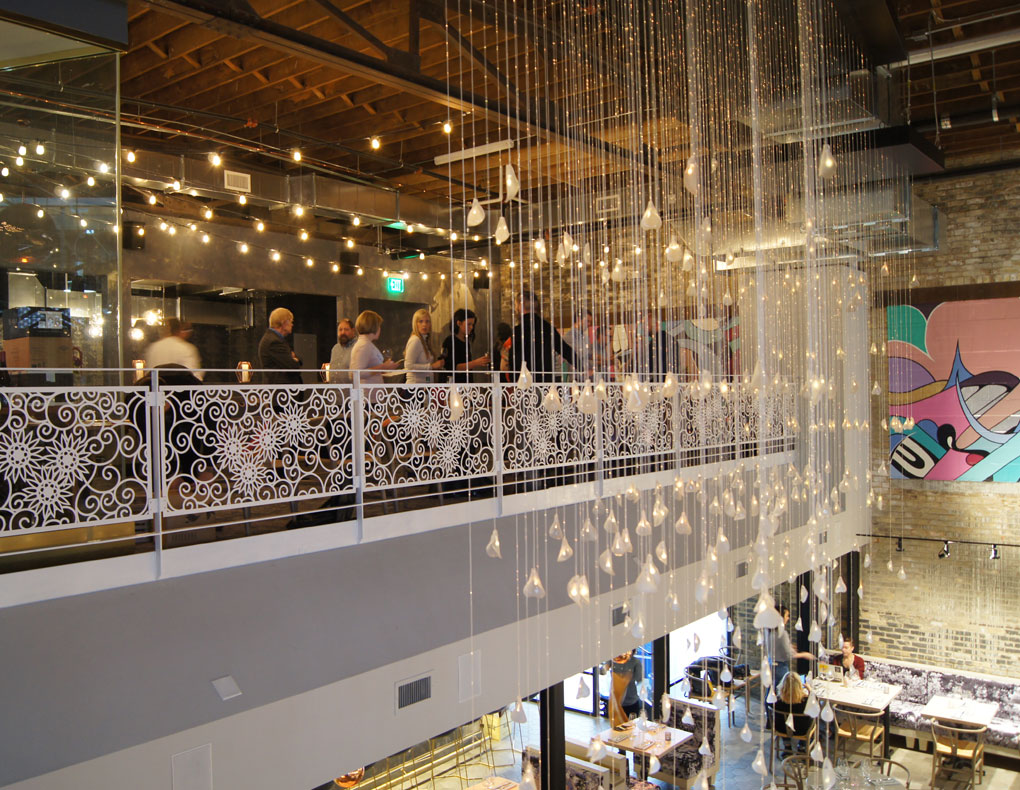
Imagine glass that frosts as people draw near, offering privacy without ever feeling heavy.
Picture screens that soften a space, guiding sight lines rather than blocking them entirely.
Or you may even consider partitions that move on a whim, sliding, pivoting, or disappearing to open a room in seconds.
Even something as simple as a wall of hanging decorative lights can transform a space, casting sparkle and shimmer, which is precisely what we incorporated into our In Bloom project (pictured above).
Modern interior design for commercial environments is all about this kind of flexibility and creating boundaries that adapt, shift, and respond to the rhythms of the day.
If you do this, a single space can serve multiple purposes with ease and elegance, becoming dozens of different shapeshifted spaces over the course of 24 hours.
Incidentally, research shared via the Harvard Business Review shows flexible office design can increase productivity substantially (though this isn’t about open plans, which largely failed).
It’s really, more broadly, about selective permeability, creating spaces that shift personality while maintaining coherence.
Our approach showcases space transformation through video: morning coffee bars becoming afternoon meeting spaces transforming into evening event venues.
One rent, three revenue streams.
This multiplicity of function creates economic resilience that can be enormously impactful.
The Psychology of Flow
Every commercial space has choreography, whether designed intentionally or created accidentally through human adaptation.
Environmental psychologist Sally Augustin has documented how spatial arrangements generate either movement or stillness, browsing or rushing.
Curved paths invite browsing, exploration, resulting in 20% longer dwell times in retail environments.
Straight lines demand efficiency, producing 30% faster throughput in operational spaces.
Interior design for commercial success uses both strategically, understanding different zones serve different purposes.
Over the years, we’ve come to realize how, when planning restaurant space planning, flow is honestly so paramount to operational success.
Don’t underestimate that flow!
Color as Biological Intervention
University-based research has found that white offices increase errors.
That’s pretty wild, right?
So then, consider how other research has shown that red increases urgency (but also stress), and blue enhances creativity while reducing speed.
These aren’t preferences but biological responses we can harness.
It kind of feels like secret, magical information because it’s not overtly “scientific” on the surface, but it can make the world of difference in commercial interior design.
It’s a fine alchemy, getting color combinations right.
But when you do, it really, truly works.
And any good interior design for commercial spaces will, therefore, zone by color strategically:
- Dusty blue for focus areas
- Warm amber for collaboration zones
- Soft green for restoration spaces.
Color can help you prescribe a space, infuse it with the energy and psychological impact you’re imagining.
We think of color as a method of performance enhancement, pre-packaged relaxation, you name it.
And it’s all backed by research, transforming subjective preference into an objective strategy.
Acoustic ROI: The Overlooked Revenue Driver
Not everyone pays acute attention to acoustics, but anyone who’s had to shout over a conversation to be heard in a restaurant knows how much acoustics matter.
In our view, the most well-designed restaurants maintain an energetic hum without overwhelming conversation.
Offices create privacy without isolation.
Libraries offer silence without sterility.
This requires treating sound as a material, something to shape, sculpt, deploy strategically.
And in our view, understanding commercial open kitchen restaurant design requires mastering both visual and acoustic elements.
Seasonal Adaptation: Spaces That Evolve
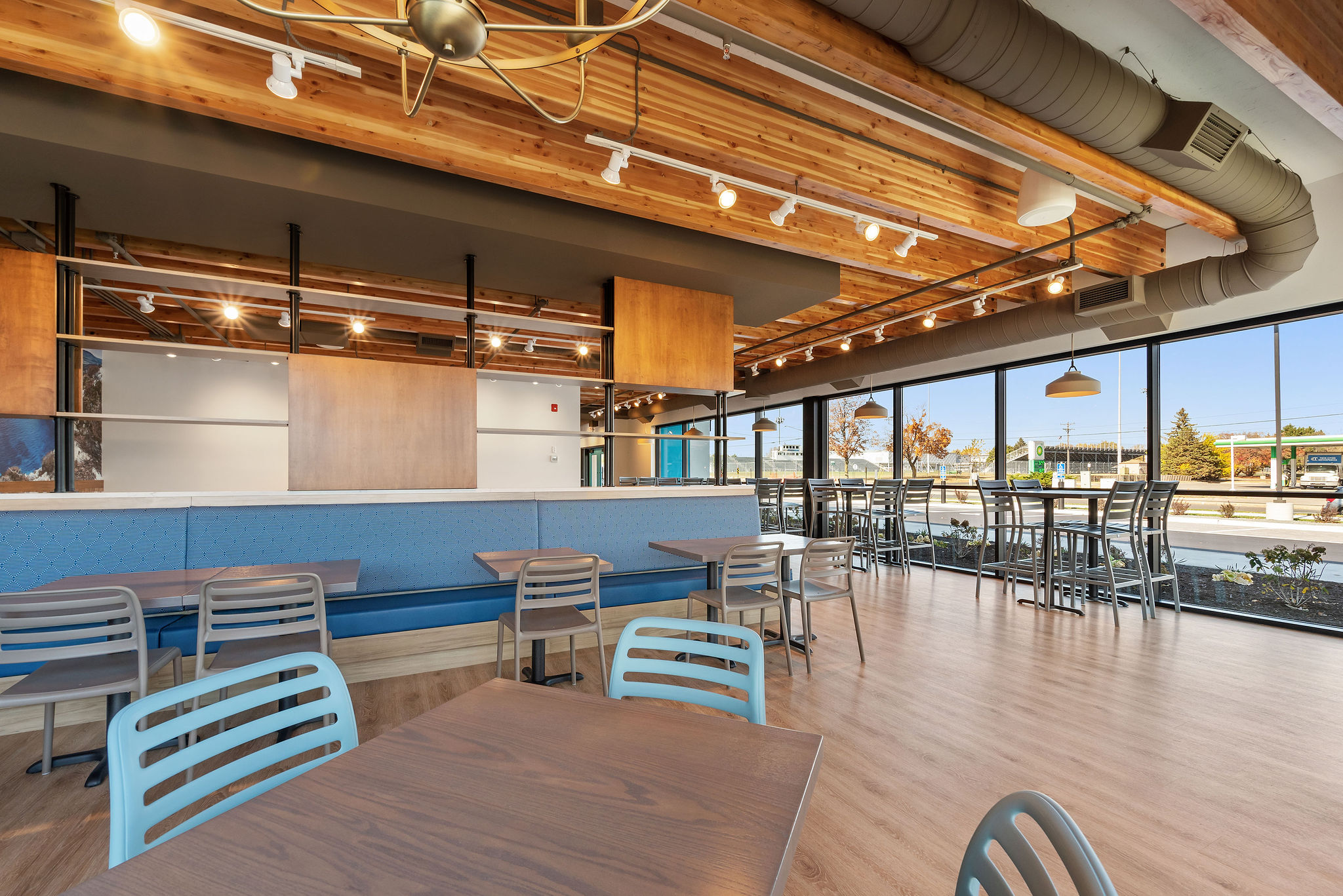
Most commercial spaces fight seasons, maintaining static conditions year-round.
Smart ones embrace seasonal change as an opportunity for renewal, relevance.
Textiles shift from linen to wool.
Lighting warms in winter, cools in summer.
Layouts expand in spring, contract in winter.
Retail research consistently shows seasonal adaptation increases sales, likely because it signals attention, care, responsiveness (all qualities clients value).
Take the same space, spin it four different ways for four different seasons, and see how foot traffic becomes a steady flow.
Scent: The Invisible Conversion Tool
Smell bypasses logic entirely, landing directly in emotional centers of the brain.
And scent marketing research shows signature scents improve mood by 40%, significantly impact purchasing decisions and space perception.
Here are a few ways we’ve tried to incorporate this thinking into our design processes, with attention to the way smell can affect experiences of a space:
Cedar suggests permanence, reliability, perfect for law firms.
Lavender offers calm, healing (ideal for healing or medicinal environments, even doctors’ offices).
Fresh bread evokes home, comfort (which can work for so many spaces, from real estate offices to clothing or homeware stores).
Interior design for commercial environments using strategic scent report consistently higher satisfaction scores and longer dwell times.
Whether designing hospitality spaces or corporate offices, scent matters.
Your subconscious doesn’t skip over it, so don’t let your planning forget it either.
We’re not saying drench the place in an Abercrombie and Fitch-esque perfume, creating an olfactory hellscape, but a light touch of an intentional scent here and there can be profoundly impactful and lingers in the mind.
Converting Design Expertise into Client Commitment
Our three-step approach for presenting commercial design projects begins with pain points: low productivity, high turnover, poor customer reviews.
We then show transformation through time-lapse renovations, compelling before-and-after metrics.
Finally, we prove ROI through revenue increases, cost reductions, satisfaction scores.
This methodology has helped our clients dramatically improve conversion rates because it repositions design from subjective preference to objective strategy.
Our recommendation?
Stop selling aesthetics, and focus on atmosphere.
Instead of just showing spaces and quoting costs, think about the many dynamic types of returns little adjustments may yield.
At Studio M, we position interior design for commercial projects as strategic investments, not decorative expenses.
We understand exceptional commercial design doesn’t just look good; it works hard, generating measurable returns through improved productivity, enhanced satisfaction, and increased revenue.
Your expertise in creating transformative commercial environments deserves presentation as sophisticated as the spaces you design.
We help you translate design intelligence into business language, demonstrating how thoughtful interior design for commercial spaces drives bottom-line results.
Don’t get me wrong: a beautiful space that doesn’t perform is just expensive theater.
But when interior design for commercial environments marries aesthetics with strategy?
That’s when your investment compounds into a competitive advantage, a unique brand, a space with a soul and a memory, that leaves a mark.
Whether you’re planning commercial building design or exploring commercial building architectural design, the principles remain: optimize for experience, design for humans, build for longevity.
The morning light is shifting, and your next project awaits.
Contact us at Studio M to discover how strategic interior design for commercial spaces elevates every aspect of your business environment.
Recent Comments